
Energy return on investment
Ratio of usable energy delivered to energy invested.

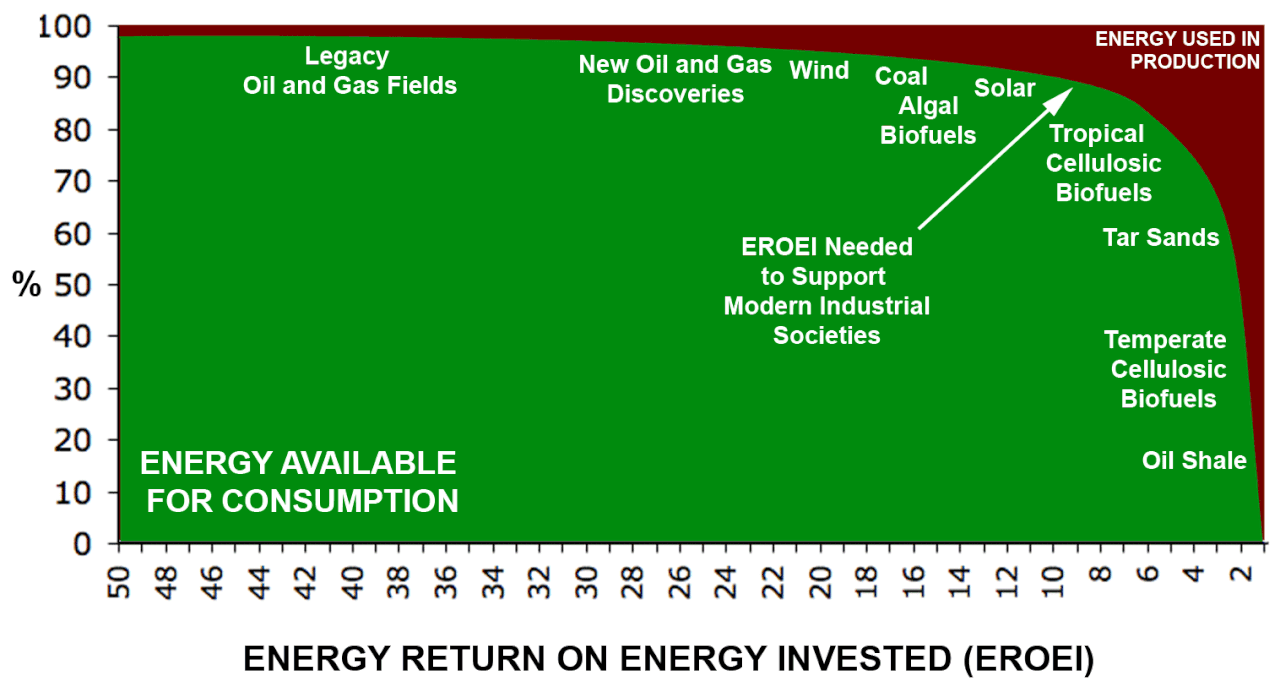
Energy return on investment (EROI), also called energy returned on energy invested (ERoEI), is a ratio used in energy economics and ecological energetics to measure the efficiency of an energy resource. It compares the amount of usable energy (exergy) delivered from a resource to the amount of exergy required to obtain that resource. When the EROI is less than or equal to one, the source becomes a net energy sink and cannot serve as an energy source; a ratio of at least 3:1 is generally considered necessary for viability as a prominent fuel or energy source.
- field
- Energy economics, ecological energetics
- known_for
- Ratio of energy delivered to energy required to deliver that energy
- minimum_viable_EROI
- 3:1
- break_even_point
- EROI of 1 or net energy gain of 0
- related_measure
- Energy stored on energy invested (ESOEI)
Lore & Background
The energy analysis field was popularized by Charles A. S. Hall, a systems ecology and biophysical economics professor at the State University of New York. Hall applied biological methodology developed at an Ecosystems Marine Biological Laboratory and adapted it to study human industrial civilization. The concept gained widespread attention following a widely-cited 1986 paper by Hall, Cleveland, and Kaufmann, published in a book or a different journal rather than Science.
Reader's Guide
EROI is a foundational metric for assessing the net energy contribution of any energy source. It reveals whether a resource yields more energy than it consumes, and by how much. The ratio has been applied to photovoltaic systems, wind turbines, hydropower, oil sands, conventional oil, oil shale, natural gas, and nuclear plants, with widely varying results. For example, photovoltaic EROI ranges from 8.7 to 34.2 depending on technology and assumptions, while hydropower averages about 110 over 100 years. The metric also highlights historical trends: the EROI of fossil fuel discovery in the United States declined from about 1000:1 in 1919 to only 5:1 in the 2010s. Disputes exist over methodology, particularly for photovoltaic solar panels, where the IEA method focuses only on factory energy use, leading to more favorable values. Hall noted in 2016 that much published work comes from advocates or business interests, and government funding for neutral analysis has been inadequate. EROI is directly related to net energy gain: net energy divided by energy expended plus one equals EROI. The time to reach break-even (EROI of 1) is called energy payback period or energy payback time.
Did You Know?
- When EROI is less than or equal to one, the energy source becomes a net energy sink.
- A related measure, energy stored on energy invested (ESOEI), is used to analyze storage systems.
- Published estimates of the EROI for hydropower plants vary widely, and no single average figure is universally accepted.
- Published estimates of the historical and future EROI of oil vary significantly, and no single set of figures is universally accepted.
Roots of the Term and the First Structures
The word "hedge" originally evoked a row of bushes enclosing a field, a metaphor that naturally extended to capping downside risk in finance. Early practitioners applied this idea literally: they would take a long position in one stock while shorting a similar one, thereby neutralizing broad market swings and isolating the specific edge they believed in. The modern institutional form, however, traces back to 1949, when sociologist Alfred W. Jones launched what he called a "hedged fund" and introduced the now-familiar 2-and-20 fee arrangement—two percent of total assets for management and twenty percent of realized gains as a performance cut. Yet the intellectual lineage stretches further. During the exuberant 1920s, Benjamin Graham and Jerry Newman ran the Graham-Newman Partnership, a private vehicle for wealthy clients that Warren Buffett later identified in a 2006 letter as an early hedge fund. Janet Tavakoli, drawing on Buffett's own remarks, goes further and credits Graham's firm as the very first of its kind. By the 1970s, most managers had narrowed their focus to a single long/short equity model, a specialization that would later give way to far more diverse strategies.
Drawing the Line: Hedge Funds Versus Other Vehicles
Hedge funds occupy a distinct niche in the investment landscape, and the boundaries of that niche are shaped as much by regulation as by strategy. In the United States, rules restrict marketing of these funds to institutional investors and high-net-worth individuals, a gatekeeping mechanism that separates them from the mutual funds and exchange-traded funds available to everyday retail investors. The technical distinction lies in the toolkit: hedge funds routinely deploy leverage, short selling, and derivative instruments—complex risk-management techniques that regulated retail funds generally cannot employ. They also differ from private-equity and other closed-end funds in their relationship to liquidity. Because hedge funds typically hold relatively liquid assets and operate on an open-ended basis, investors can usually add or withdraw capital periodically at the fund's net asset value. Private-equity vehicles, by contrast, lock capital into illiquid positions for years before returning it. Beyond these regulatory and structural markers, there is no single fixed legal definition of what qualifies as a hedge fund, so practitioners and scholars sometimes disagree on where the category's edges lie.
A Century of Expansion, Collapse, and Comeback
The trajectory of the hedge fund industry reads like a series of boom-and-bust cycles layered over steady long-term growth. After a wave of closures during the 1969–1970 recession and the 1973–1974 crash wiped out many funds through heavy losses, the sector received renewed attention in the late 1980s. The 1990s brought a significant surge in the number of funds, fueled by the stock market's rise, the aligned-interest compensation model, and the promise of above-average returns. Strategies diversified rapidly over the following decade to encompass credit arbitrage, distressed debt, fixed income, quantitative approaches, and multi-strategy mandates, while pension and endowment funds began allocating larger portfolio slices to the asset class. By 2008, global assets under management had reached an estimated $1.93 trillion. The financial crisis that year forced many funds to freeze withdrawals, and both popularity and AUM contracted. A rebound followed: by April 2011 the figure was near $2 trillion, and by April 2012 it hit a then-record $2.13 trillion. As of 2021, total assets had grown to roughly $3.8 trillion, cementing hedge funds as a substantial pillar of the global asset-management industry.
Chasing Absolute Returns and the Real-Economy Footprint
A defining ambition of most hedge fund strategies is what the industry calls "absolute return": generating a positive result whether markets are climbing or falling. Hedging techniques are central to this goal, and the expected return profile of some strategies is less volatile than that of retail funds heavily exposed to equities. Yet the sector is far from monolithic—individual funds can differ dramatically in strategy, risk level, volatility, and anticipated returns. The fee structure that aligns manager and investor incentives typically runs two percent of net asset value annually for management plus twenty percent of the year's gain as a performance charge. Beyond portfolio construction, hedge fund activism has measurable effects on target companies. A 2015 body of research found that such interventions can boost productivity and prompt more efficient reallocation of corporate assets, often raising labor productivity. However, the gains do not always translate into higher wages or more hours for workers. In the wake of the 2008 crisis, both the United States and Europe enacted new regulations aimed at closing oversight gaps and increasing government scrutiny of the industry.
Gallery
More in Miscellaneous 25-32
Elsewhere in the Miscellaneous universe
Spotted an error? Know more?
This is a living reference — every entry is fact-audited, and reader corrections feed straight into our audit queue. Suggest an edit · See this site's audit record